Lagrange equations for reaction forces
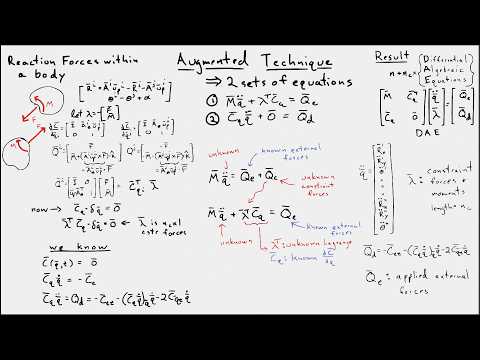
In this video, we build the full set of differential algebraic equations needed to model multibody dynamics (MBD) systems. The general approach has
\(n_b\) number of moving or fixed parts
\(3\times n_b\) generalized coordinates (in planar motion)
\(n_c\) number of constraints
a mass matrix, \(\mathbf{M}\) that is \(3 n_b\times 3 n_b\)
constraint Jacobian, \(\mathbf{C}_{\mathbf{q}}\) that is \(n_c \times n_b\)
externally applied forces from springs, gravity, dampers, motors, etc. \(\mathbf{Q}_e\) that is \(3 n_b\) long
reaction constraints, \(\mathbf{Q}_d\) that is \(n_c\) long (every constraint needs a reaction force to maintain the constraint)
The set of equations leaves two unknown vectors in the left-hand side equation,
the acceleration of each generalized coordinate \(\ddot{\mathbd{q}}\)
the reaction forces that maintain constraints, \(\lambda\)
By solving these equations at each time step, we can maintain constraints and calculate the following velocity and position of the multibody system.
To run this tutorial locally, download this file and open it with Pluto.jl.