Full Kinematic Equations for piston-crank
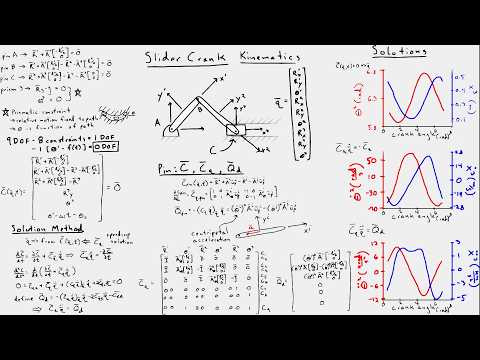
In this video, we revisit the piston-crank kinematic equations to define the kinematic constraints on acceleration,
\(\mathbf{C}_\mathbf{q} \ddot{\mathbf{q}} = -\mathbf{C}_{tt}-(\mathbf{C}_\mathbf{q} \dot{\mathbf{q}})_\mathbf{q}\dot{\mathbf{q}}- 2 \mathbf{C}_{\mathbf{q}t}\dot{\mathbf{q}}\)where subscripts denote partial derivatives i.e. \(\mathbf{C}_\mathbf{q} = \frac{\partial \mathbf{C}}{\partial \mathbf{q}}\).
These equations are especially important as we introduce degrees of freedom into multibody dynamic systems. Each degree of freedom represents a second order differential equation where,
\(\ddot{\mathbf{q}} = f(\mathbf{q},~\dot{\mathbf{q}},~t)\)because forces are usually a function of time, dislacement, or velocity and \(F = ma\).
To run this tutorial locally, download this file and open it with Pluto.jl.