What is the fastest path between two points?
We want to design a track that minimizes the time it takes to descend from height, \(h\), to height 0 and we want to travel forward by distance, \(L\).
What shape should the track take?
total time is, \(T\),
$$T = \int_0^L\frac{ds}{v}$$
For a first approximation, consider sliding without friction,
$$mgh = \frac{1}{2}mv^2 + mgf(x)$$
.
Our track can only have 1 height, \(y\) for every position, \(x\), so
$$y(x) = f(x)$$
and
$$v = \sqrt{2g(h-f(x))}$$
,
and the distance traveled is \(ds = \sqrt{dx^2+dy^2}= \sqrt{dx^2+dx^2\frac{df}{dx}^2}\) or
$$ds = dx\sqrt{1+f'^2}$$
our total time, \(T\), is now
$$T = \int_0^L\frac{ds}{v}=\int_0^L\sqrt{\frac{1+f'^2}{2g(h-f)}}dx$$
begin
using Plots
using LaTeXStrings
end
g = 9.819.81
F(f, df, h = 1) = ((1+df^2)/(2*g*(h-f))).^0.5F (generic function with 2 methods)
function T(F, f, df, L = 1, dx=0.0001)
    x = range(dx, L, step = dx)
    val = F.(f.(x), df.(x)).*dx
    T = sum(val)
    return T
end
T (generic function with 3 methods)
function build_parabola(p1, h=1, L=1)
    x1, y1 = p1
    A = [0 0 1;
         x1^2 x1 x1^0;
         L^2 L L^0]
    b = [h, y1, 0]
    C = A\b
    f(x) = C[1]*x^2+C[2]*x+C[3]
    df(x) = 2*C[1]*x +C[2]
    return f, df
end
build_parabola (generic function with 3 methods)
begin
    y1s = range(0, 0.7, step=0.05)
    T_array = zeros(length(y1s))
    P = plot([0, 1], [1, 0],
             markershape=:rect,
             linetype=:scatter,
            label = "start-stop")
    dx = 0.0001
    x = range(dx, 1, step = dx)
    for (i, y1) in enumerate(y1s)
        f, df = build_parabola([0.5, y1])
        T_array[i] = T(F, f, df, 1, dx)
        plot!(P, x, f.(x), label = "y"*string(i))
    end
plot!(P, title = "Varying paths from start to stop",
     xlabel = "X-location (m)",
     ylabel = "Y-location (m)")
plot!(ones(length(y1s)).*0.5,
      y1s,
      markershape=:circ,
      linetype=:scatter,
     label = "fixed points")
    P
end
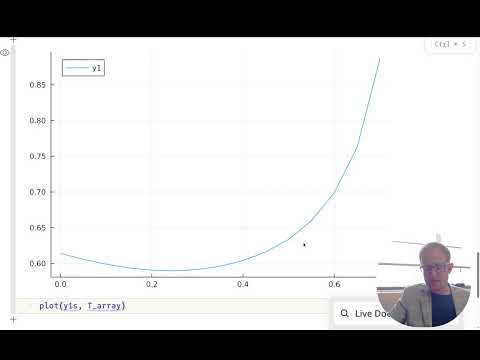
plot(y1s, T_array,
     title = "Optimizing fastest path",
    xlabel = L"Y-position fixed at $x=\frac{L}{2}$",
    ylabel = "Total time to bottom (s)")
Built with Julia 1.12.4 and
LaTeXStrings 1.4.0Plots 1.40.20
To run this tutorial locally, download this file and open it with Pluto.jl.